

The Different Types of SEO & How to Properly Strategize for Each
Search engine optimization is so much more than just adding keywords to a website and trying to rank on the first page of Google. Today, people can discover businesses through various digital platforms, including traditional search engines, AI assistants, voice search, social media, online marketplaces, maps, videos, podcasts, community forums, and more. Every channel presents a different type of search experience—and each requires its own strategic approach.
For business owners and marketing teams, the growing number of SEO categories can feel overwhelming. Terms such as technical SEO, local SEO, AEO, GEO, Amazon SEO, programmatic SEO, and brand SEO are frequently used, but not always understood unless you're in the industry, and even then, it’s a lot! More importantly, businesses are rarely shown how these strategies connect, how they align, or which ones to prioritize.
The goal isn’t to implement every type of SEO at once. A successful strategy begins by building a strong foundation: understanding how your target audience searches, identifying the platforms they use, and investing in the areas that most closely align with your business model and growth objectives.
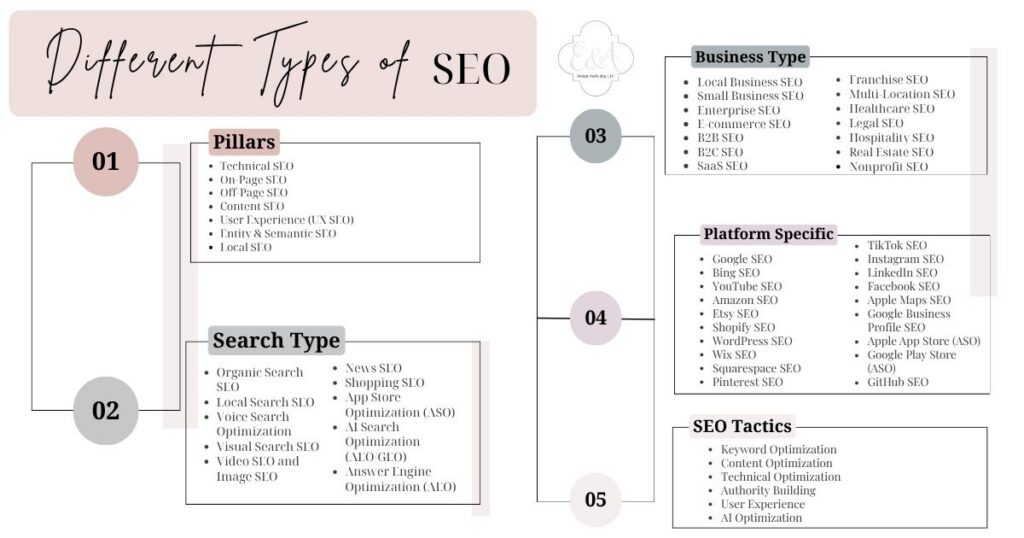
SEO is best understood as an interconnected ecosystem that serves as a foundational pillar supporting your website. At the same time, your website is the essential focus of all your digital marketing efforts, which is why platform-specific SEO is so important: it expands visibility wherever customers actively search for and discover your business. Search-type optimization helps content appear in different formats while business-specific SEO aligns the strategy with the company’s operations, and SEO tactics determine how optimization is executed. At the same time, platform-specific SEO expands visibility wherever customers actively search and can discover your business.
In this blog, we’ll go over the different types of SEO, what they are, and how to properly strategize, because even though each branch serves its own purpose, the channels need to work together to maximize results.
Foundational Pillars of SEO
Before modern optimization became a strategy for AI search on TikTok, Amazon, Google Maps, or other specialized platforms, businesses needed to establish a dependable SEO framework for their website, which is more important now than ever before because it helps set the foundation for digital success.
A weakness in one area can limit the performance of the others. For example, excellent content may struggle if a website can’t be crawled properly, while a technically strong site may fail to rank if its content doesn’t satisfy user intent. A well-optimized website may still lack visibility if it hasn’t established authority or trust beyond its own domain. Although many factors go into it, SEO is no longer viewed as a luxury but now a necessity to keep up in a constantly changing digital landscape.
1.) On-Page SEO
On-page SEO focuses on the organization of information presented on a webpage, including the content and structure that users and search engines directly encounter and engage with.
A successful strategy should begin with understanding what the user is actually trying to accomplish. Someone searching for “commercial landscaping services” may be comparing providers, while someone searching for “how much does commercial landscaping cost?” is looking for more educational and pricing guidance. Although searches are related, they require different content and conversion paths.
On-Page SEO Features:
Search engines evaluate how a page addresses overall user intent, how clearly the information is presented, and whether the content brings meaningful value compared to competing results.
Successful On-Page SEO Tactics:
Content should use descriptive headings, concise introductions, readable paragraphs, relevant examples, optimized images, and clear calls to action. Schema markup can further clarify products, services, FAQs, events, organizations, reviews, or other page elements. Existing pages should also be reviewed regularly. Updating statistics, examples, links, screenshots, services, and recommendations can produce stronger results than continuously publishing new content without maintaining older assets.
2. ) Off-Page SEO
Off-page SEO focuses on the reputation, authority, and trust a business develops from external sources. Historically, off-page SEO was treated as a numbers game in which businesses attempted to acquire as many backlinks as possible. This approach has not only become increasingly ineffective but could potentially cause more harm than good. Modern search systems don’t just consider the number of links pointing back to a website; they now factor in the relevance, credibility, context, and quality of these external signals.
There are many different types of backlinks that can point back to your site, such as digital public relations, reviews, brand mentions, partnerships, media coverage, expert contributions, podcast appearances, directory listings, and more. However, successful off-page SEO begins with creating something worth referencing that brings value to your site.
Successful Off-Page SEO Tactics:
Businesses should prioritize relevant, editorially earned links over bulk link packages or low-quality directories. They should monitor unlinked brand mentions, develop relationships with respected industry sources, contribute original expertise, and maintain consistent business information across reputable platforms.
The objective is not to manufacture authority. It is to become an organization that customers, publications, communities, and platforms naturally recognize as trustworthy.
3.) Technical SEO
Technical SEO creates the infrastructure that allows search engines to crawl, render, understand, index, and serve website content effectively. It includes site speed, mobile performance, structured data, XML sitemaps, redirects, canonical tags, crawl management, JavaScript rendering, security, indexing controls, and website architecture.
Technical SEO often operates behind the scenes, but it can directly affect every page on a website. Broken internal links, duplicate URLs, slow load times, poor mobile usability, incorrect canonical tags, or indexing errors can prevent valuable content from reaching its full potential.
The most effective technical strategy begins with a comprehensive audit. However, an audit should not simply produce a long list of errors. Issues should be prioritized based on their potential impact on crawling, indexing, user experience, conversions, and revenue.
Successful Technical SEO Tactics:
Technical SEO should also be integrated into website development rather than addressed only after problems appear. Developers, designers, content teams, and SEO professionals should collaborate before major site changes are launched. Technical teams should monitor Google Search Console, server behavior, Core Web Vitals, crawl patterns, redirects, structured data, mobile usability, and index coverage.
SEO by Search Type
People do not search in one universal way. A typed Google query, a spoken question, an image search, a YouTube search, an AI conversation, and a mobile “near me” search can all reflect different expectations. Search-type SEO focuses on adapting content to the format, device, or experience through which discovery occurs.
1. Mobile SEO: Google primarily evaluates the mobile version of a website for indexing and ranking; mobile optimization is no longer optional. Mobile SEO ensures that websites provide fast, functional, and easy-to-navigate experiences on smartphones and tablets for immediate needs such as searching for directions, operating hours, pricing, appointment availability, product information, or a phone number. Businesses should make those actions easy to complete.
2. Voice Search Optimization: Voice search optimization focuses on conversational questions spoken through mobile devices, smart speakers, vehicles, and digital assistants. Voice searches tend to be longer and more natural than typed searches.
3. Video SEO: Video SEO improves the discoverability of video content across YouTube, Google, social platforms, and video search results. Successful optimization depends on both relevance and audience engagement. However, optimization alone will not compensate for a weak viewing experience. Videos must capture attention quickly, deliver on their promise, maintain a logical pace, and provide a useful conclusion or next step. Watch time, retention, comments, shares, and repeat viewing can all influence visibility.
4. Image SEO: Image SEO helps visual assets appear in Google Images, product results, visual search tools, AI-generated responses, and platform discovery feeds. A successful image strategy begins with using original, useful visuals whenever possible. Product photographs, diagrams, charts, before-and-after images, process graphics, and branded infographics can communicate information more effectively than generic stock photography.
5. Content SEO: A strong content strategy should not begin with the question, “What can we publish this week?” It should begin with, “What does our audience need to understand before they can trust us, compare their options, or make a decision?”- Content should support every stage of the customer journey.
6. News SEO: News SEO applies to publishers, organizations, associations, and businesses producing timely or newsworthy content. It focuses on freshness, accuracy, transparency, speed, and editorial credibility. News organizations should also maintain clear editorial policies and distinguish reported facts from opinion.
AI SEO: AEO and GEO
AI SEO focuses on helping content become understandable, trustworthy, and usable within AI-powered search experiences. Answer Engine Optimization, or AEO, structures information so search engines and assistants can identify direct, useful answers.
Generative Engine Optimization, or GEO, focuses more broadly on increasing the likelihood that a brand, website, or expert is accurately represented, cited, summarized, or recommended by generative AI systems. Neither strategy replaces traditional SEO. AI systems still rely on accessible websites, structured information, established entities, recognizable brands, reliable sources, and authoritative content.
SEO by Business Type
Different business models require different SEO priorities. A local contractor, an international corporation, an e-commerce store, and an affiliate publisher should not use the same strategy or success metrics.
Local SEO: Local SEO helps businesses appear when customers search within a defined geographic area. It is essential for service providers, medical practices, restaurants, retailers, professional offices, attractions, and companies with physical locations.
Categories, services, hours, contact information, photographs, products, attributes, and business descriptions should be maintained consistently. Reviews are critical, but businesses should focus on building a steady, authentic review process rather than generating a large volume of reviews all at once. Responses should be personal, professional, and helpful.
Enterprise SEO: Enterprise SEO is designed for large organizations managing extensive websites, multiple departments, large content libraries, international markets, or thousands of products and services. At this level, the primary challenge is often not identifying optimization opportunities. It is coordinating people, technology, approvals, priorities, and implementation at scale.
Successful enterprise SEO requires clear governance. Teams need documented standards for metadata, internal linking, content creation, redirects, migrations, schema, publishing, and performance reporting.
E-commerce SEO: E-commerce SEO improves the visibility and performance of products, categories, collections, and informational pages. Product pages should use original descriptions rather than manufacturer-provided text duplicated across multiple retailers. High-quality images, videos, specifications, FAQs, shipping information, availability, reviews, and product schema can strengthen both visibility and conversions.
Affiliate SEO: Publishers and creators use affiliate SEO to earn revenue by recommending or comparing third-party products and services. Comparison pages help readers understand which option is best for different needs rather than declaring one product universally superior. Buying guides should explain how to evaluate products, not merely display a list. Strong affiliate SEO depends on credibility. Readers should understand who created the recommendation, how products were assessed, and why the conclusions are trustworthy.
White Hat SEO: White hat SEO follows search engine guidelines and prioritizes long-term value. It includes helpful content, ethical outreach, technical improvements, accessibility, authentic reviews, strong user experiences, and legitimately earned authority.
This approach may take more time than manipulative shortcuts, but it creates more durable results. White hat SEO is best suited for businesses seeking sustainable growth and a digital presence they can confidently build upon.
Gray Hat SEO: Gray hat SEO includes tactics that may not be explicitly prohibited but carry greater risk or operate outside the spirit of search guidelines. Businesses considering gray-hat tactics should carefully evaluate the potential consequences. A short-term ranking increase may not justify reputational damage, wasted investment, or future loss of visibility.
Examples may include aggressive guest posting, purchasing expired domains, exchanging links at scale, or creating content primarily to influence rankings rather than help users.
Black Hat SEO: Black hat SEO intentionally attempts to manipulate rankings through tactics that violate search engine guidelines. Examples include cloaking, hidden text, keyword stuffing, doorway pages, automated spam, hacked links, and private link networks.
These methods may occasionally produce temporary gains, but they expose businesses to penalties, deindexing, traffic loss, and reputational damage. A legitimate business should not build its long-term visibility around tactics it would be uncomfortable explaining publicly.
Parasite SEO: Parasite SEO involves publishing content on a highly authoritative third-party website to benefit from that domain’s established ranking power. The term is often associated with exploitative tactics, but the underlying concept can also be applied ethically.
The difference lies in intent and quality. Ethical third-party publishing provides value to the platform’s audience and accurately represents the contributor. Manipulative parasite SEO uses unrelated authority solely to capture rankings.
Accessibility SEO: Accessibility SEO improves website usability for people with disabilities while also supporting clearer content structure and stronger technical quality. Accessibility should not be treated as an optional SEO add-on. It is an essential component of creating inclusive and user-focused digital experiences.
Brand SEO: Brand SEO strengthens how a company is discovered, understood, and represented across search results. A strong brand SEO strategy ensures that when someone searches for the business, they encounter accurate, consistent, and trustworthy information.
Brand recognition also supports AI visibility because well-established entities are easier for search and generative systems to identify and contextualize. It includes optimizing branded search results, business profiles, social accounts, review platforms, leadership pages, press coverage, images, videos, and company information.
Programmatic SEO: Programmatic SEO uses structured data, databases, and templates to create large numbers of pages that target recurring search patterns. The strategy succeeds only when each page provides genuine, differentiated value. Businesses must also monitor whether pages receive traffic, engagement, links, or conversions and remove low-value content when necessary.
Platform-Specific SEO: Search behavior now extends far beyond traditional search engines. Each platform has its own discovery system, content formats, ranking signals, and audience expectations. Businesses should optimize only for platforms relevant to their customers and operations. Attempting to maintain every channel without adequate resources often results in low-quality execution.
Google Discover SEO: Google Discover recommends content based on individual interests rather than requiring users to enter a traditional query. Content must deliver on the promise made within the title and image. Strong visuals, compelling headlines, mobile performance, timely relevance, original insights, and established authority can support Discover visibility. Businesses should avoid misleading headlines and clickbait.
Google AI Overviews and SGE SEO: Google’s AI-generated search experiences summarize information directly within search results. Although the terminology and presentation continue to evolve, the strategic focus remains consistent: create content that is clear, well-supported, structured, credible, and useful.
AI Overview optimization should be viewed as an extension of SEO, AEO, GEO, entity optimization, and brand authority—not as an isolated tactic.
Shopify SEO: Shopify SEO combines traditional e-commerce optimization with platform-specific technical considerations. The strongest Shopify strategies integrate SEO with merchandising, email marketing, conversion optimization, paid campaigns, customer retention, and inventory planning.
Amazon SEO: Relevance, sales performance, conversions, reviews, pricing, availability, and fulfillment all heavily influence it. However, visibility and conversion are closely connected. A listing that appears in search but fails to convert may lose momentum. Product quality, reviews, price competitiveness, inventory, shipping, and customer satisfaction all contribute to performance.
Etsy SEO: Etsy SEO helps handmade, personalized, vintage, and creative products appear in Etsy search results. Successful listings should use specific, long-tail phrases that reflect how buyers describe the product. Etsy shops can also strengthen visibility by developing a cohesive niche, maintaining strong service, testing seasonal terms, and promoting listings through Pinterest, social media, email, and external search.
eBay SEO: eBay SEO depends on accurate listing information, item specifics, titles, categories, pricing, seller performance, product condition, shipping, and customer feedback. Sellers should complete as many relevant item-specific fields as possible because these details support both search visibility and buyer filtering.
App Store Optimization: ASO improves app visibility on Apple’s App Store and Google Play. Successful strategies optimize the app name, subtitle, keyword fields where applicable, description, category, screenshots, preview videos, reviews, ratings, downloads, engagement, and retention.
Podcast SEO: Podcast SEO helps shows and individual episodes appear in podcast platforms, Google results, YouTube, and broader discovery channels. Episodes should use descriptive titles, detailed show notes, transcripts, chapters, guest information, and relevant links. Vague or overly clever titles may make episodes harder to discover.
Reddit SEO: Reddit discussions frequently appear in search results and are increasingly used by consumers seeking candid experiences, comparisons, troubleshooting, and recommendations. Reddit is a community rather than an advertising platform. Genuine participation, transparency, useful answers, and respect for subreddit rules are essential.
Quora SEO: Quora allows users and experts to answer specific questions. Well-written answers can appear in both platform search and traditional search results. Successful answers should address the question directly, provide context, include examples, and avoid unnecessary promotion. Businesses can build authority by consistently answering questions within their area of expertise.
YouTube SEO: YouTube operates as both a search engine and a recommendation platform. The opening moments of a video are especially important. Creators should quickly confirm what the video will cover and why viewers should continue watching. A consistent focus on topics can also help YouTube better understand the intended audience and recommend related videos more effectively.
TikTok SEO: TikTok users increasingly search for tutorials, recommendations, products, destinations, reviews, and explanations. Videos should answer the question quickly, maintain attention, and feel native to the platform. Overly polished advertising may underperform compared with authentic, useful, and personality-driven content.
LinkedIn SEO: Improves the visibility of profiles, company pages, services, articles, posts, newsletters, and job listings. Individuals should use accurate professional keywords within headlines, summaries, experience sections, skills, and content. Companies should maintain complete profiles, consistent descriptions, employee connections, and active publishing.
Pinterest SEO: Pinterest is a visual search and discovery platform where users plan purchases, projects, events, travel, home improvements, recipes, fashion, and creative ideas. Pinterest content can continue generating traffic long after publication, making it especially valuable for evergreen and seasonal strategies.
Google Maps SEO: Google Maps SEO is a major component of local search. Visibility depends on relevance, proximity, prominence, business information, reviews, categories, website signals, and local authority. Businesses should fully optimize their Google Business Profile, maintain accurate information, select appropriate categories, upload current photographs, publish updates, respond to reviews, and ensure the linked website reinforces local services.
TripAdvisor SEO: TripAdvisor SEO is especially important for hotels, restaurants, attractions, tour companies, and travel-related businesses. Profiles should contain accurate descriptions, categories, amenities, contact details, hours, booking information, and high-quality images. Businesses should encourage authentic reviews after customer experiences and respond professionally to both positive and negative feedback.
Which Types of SEO Should Your Business Prioritize?
Not every business needs the same combination of strategies. Priorities should be based on audience behavior, resources, competition, business goals, and the platforms influencing customer decisions. A business should generally begin with the areas closest to revenue and customer behavior.
SEO strategies are most effective when they work together rather than operating as separate projects. Platform-specific distribution places it in front of people beyond Google.
A content team may create an excellent guide, but technical SEO ensures it can be indexed. On-page SEO clarifies its purpose. Off-page SEO strengthens its authority. Video and image SEO expand their format. AI optimization makes it easier to summarize. Brand SEO helps audiences recognize the source. Businesses should begin by auditing their current digital presence. This includes website performance, content quality, keyword visibility, local listings, reviews, brand consistency, backlinks, platform profiles, conversion paths, and analytics.
SEO Is No Longer One Strategy
The definition of search has expanded, but the purpose of SEO remains the same: helping the right audience discover, understand, trust, and engage with a business. The businesses that succeed will not necessarily be those that attempt every SEO tactic or publish the most content. They will be the organizations that build the strongest, most consistent digital ecosystems.
That means creating a technically sound website, publishing genuinely useful information, strengthening brand authority, earning trust beyond the website, and showing up wherever customers search. Traditional SEO, local optimization, AI search, marketplace visibility, video discovery, social search, and platform-specific strategies should not compete for attention. They should support one another. By understanding the different types of SEO and strategically selecting the ones most relevant to your audience, you can build sustainable visibility, stronger customer relationships, and a trusted digital presence capable of evolving alongside the future of search.
Ready to Build the Right SEO Strategy?
Your business does not need every type of SEO—it needs the combination that supports your customers, goals, and long-term growth.
At E&A Design Marketing, we help businesses identify the search opportunities that matter most, strengthen their digital foundations, and develop people-first strategies that connect traditional SEO with AI-powered search, brand visibility, content marketing, and emerging discovery platforms.
Whether you are looking to improve website performance, expand local visibility, strengthen ecommerce growth, prepare for AI search, or build a more consistent digital presence, the right strategy begins with understanding where you are today—and where your customers are searching next.